

Tile installation is often associated with choosing the right tiles, adhesive and grout. But for professional installers, the quality and speed of the finished job also depend heavily on having the best power tools for tile installation.
From cutting porcelain and ceramic tiles to drilling through concrete for plumbing or electrical work, a tile installation project can involve several different applications. Using one tool for everything can lead to slow progress, inaccurate cuts, unnecessary material damage and operator fatigue.
The better approach is to build a practical toolkit where each power tool has a specific role.
In this guide, we’ll look at the essential power tools professionals actually need for tile installation, including marble cutters, angle grinders, rotary hammer drills, laser measuring tools and wet & dry vacuums. We’ll also look at when corded or cordless tools make more sense and how to choose the right combination for your work.
Quick Answer: What Power Tools Do Tile Installers Need?
For most professional tile installation jobs, a well-rounded power tool kit should include:
- Marble cutter – for straight and controlled tile, marble and stone cuts.
- Cutting Blades – for cleaner cutting of ceramic, porcelain and other hard materials
- Angle grinder – for trimming, shaping, notches and detailed cuts.
- Rotary hammer drill – for drilling into concrete, masonry and other hard substrates.
- Laser measuring tool – for accurate measurements and layout.
- Wet & dry vacuum – for removing dust, debris and water from the work area.
The exact combination depends on the type of tile, installation environment and substrate. A bathroom renovation, for example, may require more drilling and detail work, while large-format tile installation may place greater emphasis on accurate cutting and measurement.
Marble Cutters: The Main Tool for Tile Cutting
For professional tile installation, a dedicated marble cutter is one of the most useful power tools to have.
Unlike a general-purpose drill or grinder, a marble cutter is designed around controlled cutting. It can be used for straight cuts across materials such as ceramic tile, marble, granite and other stone products, depending on the machine and compatible cutting accessory.
The right model should provide enough power for the material while remaining manageable enough for repeated cuts throughout the working day.
ID MC4: Compact Power for Everyday Cutting
The ID MC4 Electric Marble Cutter is a practical choice for installers who need a compact tile cutting machine for common tile and stone applications.
It features a 1050W motor, a no-load speed of 13,300 RPM, a maximum blade diameter of 110mm and a maximum cutting depth of 34mm.
That combination makes it suitable for contractors and tilers handling everyday cutting requirements where portability and cutting control are important.
For standard renovation projects, bathroom work, flooring installations and general stone cutting, a compact machine like the ID MC4 can be easier to handle than a larger cutting tool.

Ideal ID MC4 – Reliable cutting power for professional tiling work.
Shop the Ideal ID MC4 NowID MC02-110HQ: Wet Cutting for Stone and Tile
When cutting materials such as ceramic tile, porcelain, marble or granite, dust management and cutting control become particularly important.
The ID MC02-110HQ Electric Marble Cutter is designed for wet cutting and combines a 1250W motor with a 13,000 RPM no-load speed and a maximum cutting depth of 30mm.
Its integrated water-cooling system is particularly useful when working with hard stone and tile materials. Wet cutting can help control heat and improve the cutting process while also reducing airborne dust compared with dry cutting.
This makes the model a strong option for professional installers working regularly with harder tile and stone materials.

Ideal ID MC02-110HQ – Reliable cutting power for demanding stone and tile projects.
Shop the Ideal ID MC02-110HQ NowID MCH180: For Larger and Deeper Cuts
Some projects involve thicker stone or require a larger cutting capacity.
The ID MCH180 Electric Marble Cutter provides a larger 180mm blade capacity and a maximum cutting capacity of 60mm, making it more appropriate when a compact 110mm cutter is not enough.
This type of machine can be particularly useful for heavier stonework, thicker materials and applications where additional cutting depth is required.

Ideal ID MCH180 – Deep-cutting power for thick stone and heavy-duty applications.
Shop the Ideal ID MCH180 NowWatch the Ideal ID MCH180 Electric Marble Cutter in action, built for deeper cutting applications with its 180mm blade capacity.
Which Marble Cutter Should You Choose?
Think about the material and cutting depth first.
| Model | Material and Cutting Depth Requirements |
|---|---|
| ID MC4 | General tile and stone work |
| ID MC02-110HQ | Wet cutting and harder materials |
| ID MCH180 | Thicker stone and deeper cuts |
For installers who regularly handle different materials, choosing a cutter based on the actual cutting requirements of the job is more important than simply choosing the highest wattage.
Cutting Blades: Choose the Right Blade for the Application
A cutting machine is only part of the cutting setup. The blade also plays an important role in achieving a clean and controlled cut.
Ideal Power Tools currently offers ceramic rim blades in different sizes and configurations. The available options include the ID CRB4.5, ID CRB7 and ID CRB9, with each designed for a specific compatible machine size and application.
| Blade Model | Dimensions | Intended Equipment Compatibility |
|---|---|---|
| ID CRB4.5 Ceramic Rim Blade | 4.5-inch (115 × 1.4 × 8mm) | Listed as a marble cutter accessory. Features a 22.23mm bore. |
| ID CRB7 Ceramic Rim Blade | 7-inch (180 × 1.6 × 8mm) | Listed as a circular saw accessory. Accepts a 180mm blade. |
| ID CRB9 Ceramic Rim Blade | 9-inch (230 × 1.8 × 8mm) | Listed as a 9-inch circular saw accessory. Accepts a 230mm blade. |
ID CRB4.5 Ceramic Rim Blade: It features a continuous rim and is designed for cutting ceramic and porcelain tiles as well as other suitable hard materials. Its 1.4mm profile is intended to support precise cutting while reducing material loss. Always confirm the machine's blade diameter, arbor size and operating specifications before fitting an accessory.
ID CRB7 Ceramic Rim Blade: For larger compatible equipment. Its 7-inch size makes it suitable for compatible larger cutting equipment where the machine is designed to accept a 180mm blade.
ID CRB9 Ceramic Rim Blade: The largest of these three ceramic rim blade options. It is intended for compatible equipment that accepts a 230mm blade.
When choosing a cutting blade, do not select one based only on the material you are cutting. The blade diameter, arbor size, machine compatibility and operating requirements should all match the equipment being used.
Explore Ideal Ceramic Rim Blades – 4.5", 7", and 9" options for precise tile and ceramic cutting.
Angle Grinders: For Trimming, Notches and Detail Work
A marble cutter is excellent for controlled straight cuts, but tile installation rarely consists entirely of straight lines.
Installers often need to make:
- Small adjustments around walls
- Notches around pipes
- Cuts around electrical outlets
- Edge trimming
- Irregular or curved cuts
- Surface preparation
- Minor grinding and finishing work
This is where an angle grinder becomes extremely useful.
IDU AG-B125: Cordless Freedom on the Jobsite
A cordless angle grinder can be especially convenient when working in unfinished buildings, bathrooms or areas where power access is limited.
The IDU AG-B125 from the Ideal Ultra cordless range provides the mobility needed for detail work without constantly managing a power cable.

Ideal IDU AG-B125 – Cordless performance for demanding jobsite tasks.
Shop the Ideal IDU AG-B125 Now
For installers moving between rooms or working in areas where extension cables become inconvenient, cordless equipment can make small cutting and grinding tasks faster and easier.
You can explore the wider Ideal Ultra cordless range when building a cordless-focused professional toolkit.
ID AG125NH: A Practical Corded Option
For installers who prefer continuous corded operation, the ID AG125NH is another option within the Ideal angle grinder range.
Corded grinders can be useful when working for extended periods because there is no need to stop and change batteries. They are particularly practical in workshops, established construction sites and renovation areas with reliable power access.

Ideal ID AG125NH – Built for extended grinding and cutting applications.
Shop the Ideal ID AG125NH Now
The important point is not that cordless is always better or corded is always better. The right choice depends on how the tool will actually be used.
Rotary Hammer Drills: Essential for Concrete and Masonry
Tile installation is not just about the tile itself.
Before the tile goes onto the wall or floor, installers may need to drill into concrete or masonry for: Plumbing supports, Bathroom fixtures, Electrical conduits, Wall-mounted accessories, Anchors, Brackets, Pipework, Other MEP installations.
This is where a rotary hammer drill becomes an important part of the professional toolkit.
A standard drill may be sufficient for some lighter materials, but concrete and masonry require a tool designed to deliver impact energy efficiently.
Ideal's rotary hammer range includes multiple sizes and configurations, allowing installers to choose a tool according to drilling requirements.
| Model | Best Suited For |
|---|---|
| ID HD2-24SRE | General construction and installation work where drilling requirements are moderate and portability matters. |
| ID HD2-26SRE | Demanding drilling and light demolition applications where additional impact performance is useful. |
| ID HD2-26QC | Users who want more flexibility. Quick-change chuck configuration allows the user to switch between drilling setups. |
| IDU HD-B26 | Brushless Cordless alternative for mobility. Useful during renovation work, remote areas, or unfinished buildings. |
For a deeper explanation of rotary hammers and how they compare with other concrete tools, see the Concrete Tool Guide.

Professional tile installation and precision masonry drilling with the IDEAL ID HD2-26SRE Rotary Hammer.
Laser Measuring Tools: Accuracy Before Cutting
One of the easiest ways to waste tile is to make a measurement error.
A few millimetres can make a major difference when installing tiles around:
- Door frames
- Windows
- Columns
- Plumbing points
- Wall corners
- Floor transitions
- Built-in fixtures
A laser measuring tool can make the measurement process faster and more consistent.
ID LMS-50: 50-Metre Laser Measurement
The ID LMS-50 Laser Measure provides a measurement range of up to 50 metres and includes functions such as area, volume and Pythagorean calculations.
For tile installers, these functions can be useful when measuring rooms, calculating areas and checking dimensions before ordering or cutting materials.

Ideal ID LMS-50 – 50-metre laser measurement for precise jobsite calculations.
The key advantage is not simply the distance it can measure. It is the ability to reduce repetitive manual measurements and improve consistency during layout work.
Professionals who need greater range can also look at the ID LM-100 within Ideal's measuring tools range.

Ideal ID LM-100 – 100-metre precision for demanding measurement tasks.
Wet & Dry Vacuum: The Cleanup Tool Professionals Shouldn't Ignore
Cutting and drilling create waste.
Tile installation can generate: Fine dust, Tile fragments, Masonry debris, Saw residue, Water, General construction waste.
Leaving this material around the work area can slow down installation and create an unnecessarily messy or hazardous workspace.
A professional wet & dry vacuum can therefore be a valuable part of the overall toolkit.
ID VC35HQ: 1500W Wet & Dry Vacuum
The ID VC35HQ is equipped with a 1500W motor, 2000 mBar suction, a 35-litre tank and wet & dry cleaning capability.
The large tank is useful for longer cleaning sessions, while the wet and dry functionality provides flexibility when dealing with both dry construction debris and liquids.

Ideal ID VC35HQ – 1500W power with a 35L capacity for efficient cleanup.
For tile installers, a vacuum like this can be used during preparation, installation and final cleanup rather than being treated as a tool that is only needed after the work is finished.
Corded vs Cordless Power Tools for Tile Installation
The choice between corded and cordless tools depends heavily on the working environment.
Corded tools make sense when:
- You work from a reliable power supply.
- The tool will be used continuously.
- You need consistent operation without battery changes.
- The project is located in a workshop or established site.
- Heavy-duty cutting or drilling is required for long periods.
Cordless tools make sense when:
- You move frequently between rooms.
- Power outlets are limited.
- Extension cables create a trip hazard.
- You need maximum mobility.
- You regularly perform short detail tasks.
For many professional installers, the best approach is not to choose one technology exclusively. A combination can be more practical: corded machines for intensive cutting and continuous work, with cordless tools for mobile drilling, trimming and detail applications.
What Does a Complete Professional Tile Installation Toolkit Look Like?
A professional tile installation setup does not need every power tool available. It needs the right tools for the workflow. A practical setup could include:
- Primary Cutting: ID MC4 or ID MC02-110HQ for everyday tile and stone cutting.
- Cutting Blades: ID CRB4.5, ID CRB7 or ID CRB9, depending on the compatible cutting machine and required blade size.
- Heavy or Deep Cutting: ID MCH180 when larger blade capacity and deeper cuts are required.
- Detail Cutting and Grinding: An Ideal angle grinder, such as the IDU AG-B125 for cordless work or a suitable corded model from the angle grinder range.
- Concrete and Masonry Drilling: An ID HD2-24SRE, ID HD2-26SRE, ID HD2-26QC or IDU HD-B26, depending on drilling requirements and mobility needs.
- Measurement: An ID LMS-50 or ID LM-100 laser measure for accurate site measurements and layout.
- Cleanup: An ID VC35HQ wet & dry vacuum for dust, debris and water removal.
This combination covers most of the power-tool requirements that can arise during a professional tile installation project.
How to Choose the Right Power Tools for Tile Installation
Before purchasing equipment, ask five questions.
- What materials do you normally install? Ceramic, porcelain, marble, granite and natural stone can have different cutting requirements. Choose the cutting machine based on the materials you actually handle rather than buying based purely on motor wattage.
- What cutting depth do you need? If your typical work involves standard tiles, a compact marble cutter may be sufficient. If you regularly work with thicker stone, a larger machine such as the ID MCH180 may make more sense.
- How much concrete drilling do you perform? If drilling is occasional, a compact rotary hammer may be enough. If your work frequently involves anchors, fixtures and heavy masonry drilling, consider a more capable model such as the ID HD2-26SRE.
- Do you need maximum mobility? If you work across multiple rooms or unfinished sites, cordless tools can save time and reduce cable management. If the tool stays in one location and operates continuously, corded equipment may be more practical.
- Are you considering the entire workflow? Don't focus only on the main cutting machine. Professional productivity comes from the complete process: Measure → Mark → Cut → Drill → Install → Clean. A good toolkit should support every stage.
Common Mistakes When Choosing Tile Installation Tools
- Choosing one tool for every application: A marble cutter, angle grinder and rotary hammer perform completely different jobs. Trying to replace all three with one tool usually compromises productivity.
- Buying based only on wattage: Higher wattage does not automatically mean a tool is better for your application. Consider cutting capacity, impact energy, speed, tool size, ergonomics and the type of material being worked on.
- Ignoring the substrate: Installing tile over concrete is different from working on drywall, blockwork or other surfaces. The drilling tool should match the substrate.
- Forgetting measurement equipment: A powerful cutter cannot fix an incorrect measurement. Accurate layout should happen before cutting begins.
- Treating cleanup as an afterthought: Dust and debris can quickly accumulate during cutting and drilling. Having a suitable vacuum available helps maintain a cleaner and more productive work area.
- Ignoring safety: Power tools should always be used according to the manufacturer's instructions, with appropriate protective equipment and safe working practices. For a broader checklist, review the Power Tool Safety Checklist before starting demanding cutting or drilling work.
Frequently Asked Questions
What is the most important power tool for tile installation?
For cutting tiles, a dedicated marble cutter is usually one of the most important power tools. However, professional installers often need additional equipment such as an angle grinder, rotary hammer, measuring tool and vacuum depending on the project.
Can a marble cutter cut porcelain tiles?
Yes, suitable marble cutters can be used for porcelain tile when the machine and compatible cutting accessory are appropriate for the material and application. Always follow the manufacturer's operating instructions.
Do tile installers need a rotary hammer?
Not for every project, but a rotary hammer is highly useful when the installation involves drilling into concrete or masonry for anchors, plumbing, electrical work or fixtures.
Is a cordless angle grinder useful for tile installation?
Yes. A cordless angle grinder can be particularly useful for detail cutting, trimming and notching where mobility is more important than continuous operation.
What is the best tool for measuring a tile installation area?
A laser measuring tool provides a fast and convenient way to measure room dimensions, distances and areas before cutting or ordering materials.
Why should a tile installer use a wet and dry vacuum?
Tile installation can create both dry debris and water. A wet & dry vacuum provides greater flexibility for maintaining the work area during and after installation.
Should I buy corded or cordless tile installation tools?
It depends on the job. Corded tools are useful for continuous heavy-duty work, while cordless tools provide greater mobility. Many professionals benefit from having both.
Final Thoughts
The best power tools for tile installation are not necessarily the most powerful machines available. They are the tools that match the material, application and workflow.
A dedicated marble cutter handles primary tile and stone cutting. An angle grinder provides flexibility for notches and detail work. A rotary hammer takes care of concrete and masonry drilling. A laser measure improves layout accuracy, while a wet & dry vacuum helps maintain a cleaner and more productive workspace.
For professional installers, the goal is to build a toolkit where every machine has a clear purpose. With the right combination of cutting, drilling, measuring and cleanup equipment, tile installation becomes faster, more controlled and more consistent from the first measurement to the final installation.
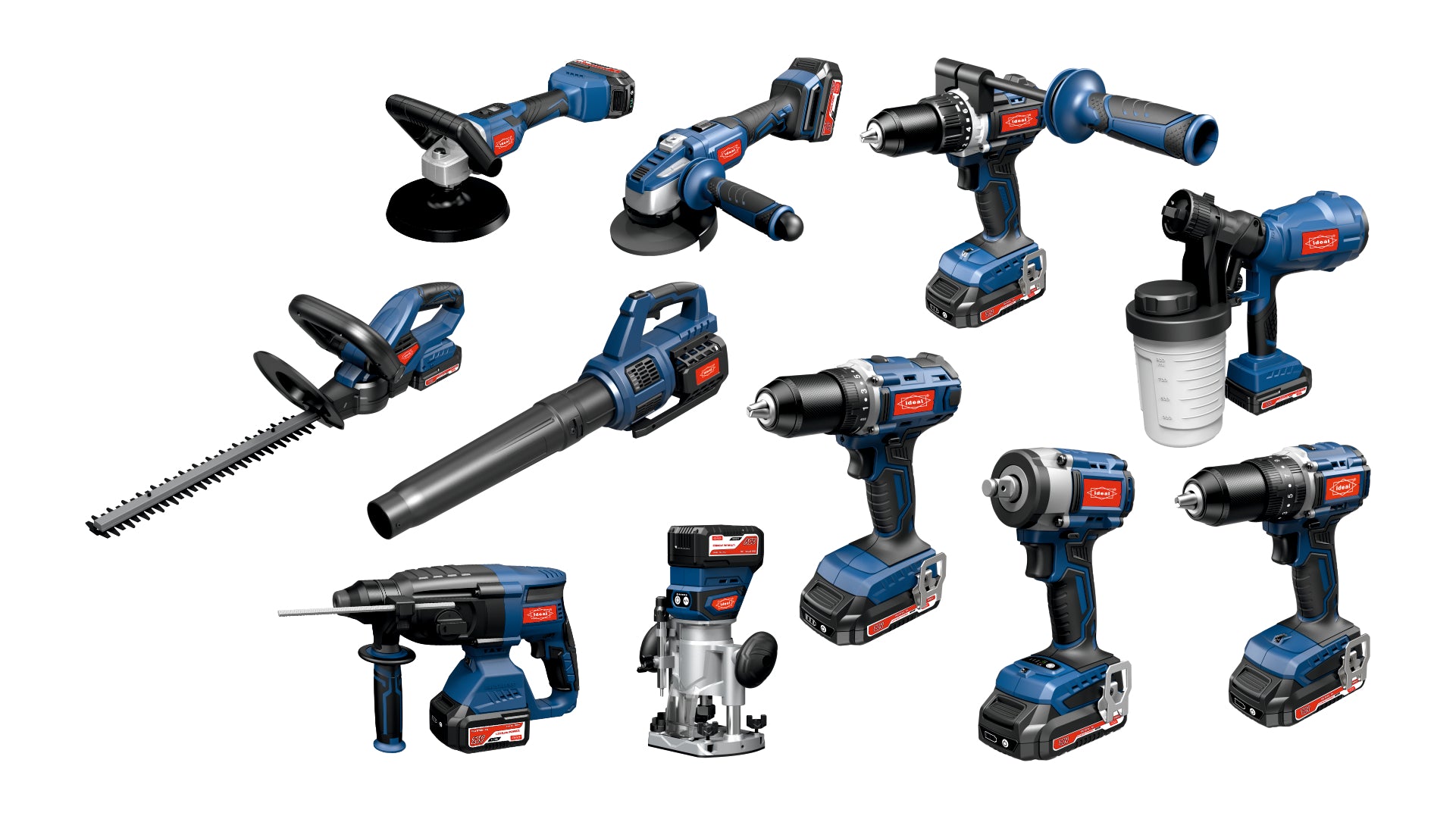
Explore the complete range of Ideal Power Tools to build a professional toolkit suited to your next project.