




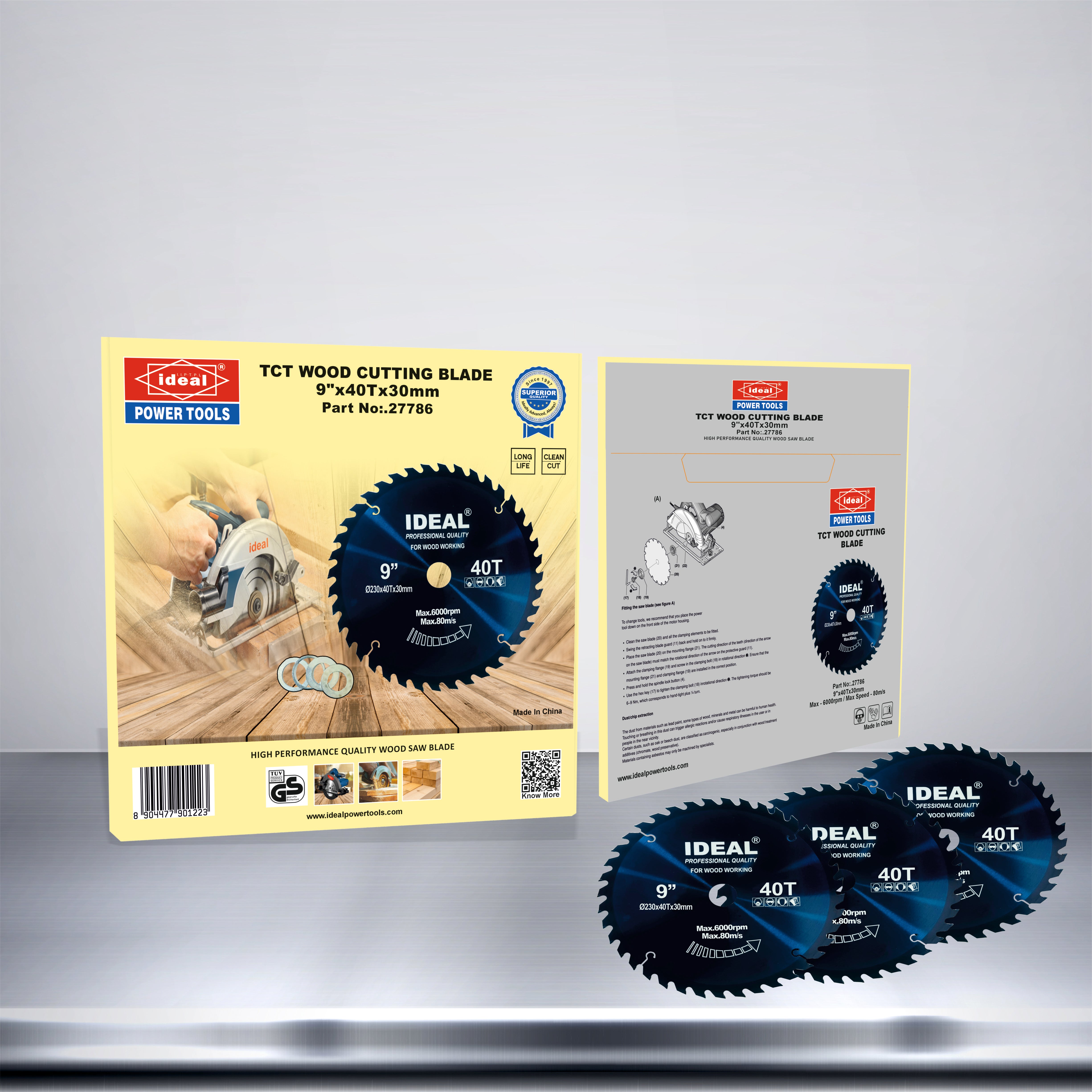
IDEAL TCT BLADE [WOOD] [9" X 40T] [30MM BORE] [230 X 40T X 1.6 X 30] [IGS PRO] CIRCULAR SAW ACCESSORY - 27786

 Chat with us
Choose options
Engineered to Cut Cleaner, Last Longer, and Perform Harder.
The IDEAL TCT Blade [Wood] is a professional-grade 230mm circular saw blade engineered for demanding woodworking applications. Featuring 40 Tungsten Carbide Tipped (TCT) teeth, a 30mm bore, and a maximum cutting speed of 6,000 RPM, this blade delivers clean, precise cuts through hardwood, softwood, and engineered timber, making it the go-to choice for tradespeople and serious woodworkers.
| Key Features | Perfect For |
|---|---|
|
|
- 230mm (9") Blade Diameter with 30mm Bore: The large 230mm cutting diameter provides substantial depth of cut, making it suitable for ripping through thick timber sections and sheet materials in a single pass. The 30mm bore ensures a secure, wobble-free fit on a wide range of standard circular saws, eliminating vibration and improving cut quality.
- 40 Tungsten Carbide Tipped (TCT) Teeth: Each tooth is precision-ground from industrial-grade tungsten carbide, one of the hardest materials available, and brazed onto the steel body for maximum retention strength. The 40-tooth configuration strikes the ideal balance between cutting speed and surface finish, producing smooth edges on both rip cuts and cross-cuts without excessive tear-out.
- Maximum Cutting Speed of 6,000 RPM (80 m/s): Rated for a maximum no-load speed of 6,000 RPM and a peripheral velocity of 80 m/s, this blade is compatible with the full range of professional corded and cordless circular saws. The high-speed rating ensures the blade maintains its geometry and balance even under sustained load, reducing heat build-up and prolonging tooth life.
- Heavy-Duty Steel Plate Body: The blade body is manufactured from high-tensile steel, laser-cut for dimensional accuracy and tensile-stress-relieved to prevent warping under thermal cycling. Expansion slots machined into the plate absorb heat generated during cutting, keeping the blade flat and true throughout extended use, a critical factor for maintaining cut accuracy on long rip cuts.
- Supplied with Blade and Washer Set: The package includes the TCT blade and a complete washer set, ensuring you have everything needed for immediate installation. The washers provide the correct clamping surface and protect the blade flange, contributing to a secure, vibration-free mount on your saw's arbor.
General Purchase & Comparison Queries
What makes the IDEAL TCT Blade better than a standard HSS circular saw blade?
Unlike standard High-Speed Steel (HSS) blades, the IDEAL TCT Blade uses individually brazed Tungsten Carbide Tips — a material significantly harder and more heat-resistant than HSS. This means TCT teeth retain their cutting edge far longer, especially when cutting abrasive materials like hardwood, MDF, or plywood. In practical terms, you get more cuts per blade, less frequent blade changes, and consistently cleaner results throughout the blade's lifespan. For professional use or high-volume cutting, the TCT blade is the clear choice.
Is this blade compatible with my circular saw?
This blade has a 230mm (9") diameter and a 30mm bore, which is a widely used standard across professional circular saws from major brands. To confirm compatibility, check your saw's specifications for the maximum blade diameter it accepts and the arbor (spindle) size — both must match. If your saw has a smaller arbor, a reducing ring (not included) can be used to adapt the bore. Always verify your saw's maximum RPM rating is at or above 6,000 RPM before fitting this blade.
Why should I choose a 40-tooth blade over a blade with fewer or more teeth?
Tooth count directly affects the trade-off between cutting speed and surface finish. Blades with fewer teeth (e.g., 24T) remove material faster but leave a rougher edge — ideal for framing and rough carpentry. Blades with more teeth (e.g., 60T+) cut slower but produce a finer finish — suited for fine joinery. The 40-tooth configuration on this IDEAL blade is a professional all-rounder: fast enough for productive site work, yet refined enough to produce clean edges on cabinetry panels and furniture components without requiring secondary sanding in most applications.
Product-Specific and Usage Queries
What types of wood can this blade cut?
The IDEAL TCT Blade [Wood] is designed for a broad range of wood-based materials. It performs excellently on softwoods (pine, spruce, cedar), hardwoods (oak, beech, walnut), plywood, MDF, chipboard, and OSB. The 40 TCT teeth handle the varying densities and grain structures of these materials with consistent results. It is not intended for cutting metal, masonry, or plastics — always use the correct blade type for non-wood materials.
How do I install the blade correctly and safely?
Always disconnect the saw from its power source before changing blades. Remove the existing blade by loosening the arbor bolt — note that many saws use a left-hand thread on the bolt, so it tightens clockwise. Fit the included washer set as directed by your saw's manual, then mount the TCT blade with the tooth direction arrow matching the saw's rotation direction (typically marked on the blade guard). Tighten the arbor bolt firmly but do not over-torque. Perform a no-load spin test before cutting to confirm the blade is seated correctly and runs true.
How do I know when the blade needs to be replaced or resharpened?
Key indicators that your TCT blade needs attention include: the saw requiring noticeably more feed force to maintain cutting speed; burn marks or scorch lines appearing on the cut surface; increased splintering or tear-out on what were previously clean cuts; and visible chipping or rounding of the carbide tips when inspected closely. TCT blades can be professionally resharpened multiple times before the tips are exhausted, making them a cost-effective long-term investment. Replace the blade immediately if the plate is warped, cracked, or if any teeth are missing.
Problem/Solution-Oriented Queries
My cuts are splintering badly on the top face of the wood. What can I do?
Splintering (tear-out) on the top face is typically caused by the blade's teeth exiting the material upward through the surface. The most effective solution is to cut with the good face of the material facing downward, since circular saw blades cut on the upstroke and tear-out occurs on the top face. Additionally, ensure the blade is sharp and clean — a dull or resin-coated blade requires more force and causes more tear-out. Reducing feed speed slightly and using a scoring line or masking tape along the cut line can also significantly reduce splintering on veneered or finished panels.
The blade is cutting slowly and the motor sounds strained. What is wrong?
This is a classic sign of a dull or resin-clogged blade. Over time, wood resins and pitch accumulate on the carbide teeth, insulating them and dramatically reducing cutting efficiency — even if the tips themselves are not yet worn. Clean the blade using a dedicated blade cleaning solution or oven cleaner applied to the teeth, left for a few minutes, then scrubbed with a stiff brush and rinsed. If cleaning does not restore performance, the blade likely needs professional resharpening. Also check that the blade is mounted correctly and that the arbor bolt is fully tightened, as a loose blade will slip and cut inefficiently.
The blade is drifting off my cut line. How do I fix this?
Blade drift is most commonly caused by one of three issues: a warped or untensioned blade, an incorrectly set saw fence or guide, or uneven feed pressure during the cut. First, inspect the blade visually for any lateral warp — a warped blade cannot track straight and must be replaced. Next, check that your rip fence or straight-edge guide is parallel to the blade and locked securely. Finally, apply consistent, even feed pressure and let the blade do the work — forcing the saw sideways to compensate for drift will worsen the problem. Ensuring the blade is sharp and properly tensioned is the most reliable long-term fix.
Blade (1 Pcs), Washer (1 Set)