

IDEAL POINTED CHISEL [30 X 410] [PH65] DEMOLITION HAMMER ACCESSORY - 20334

 Chat with us
Choose options
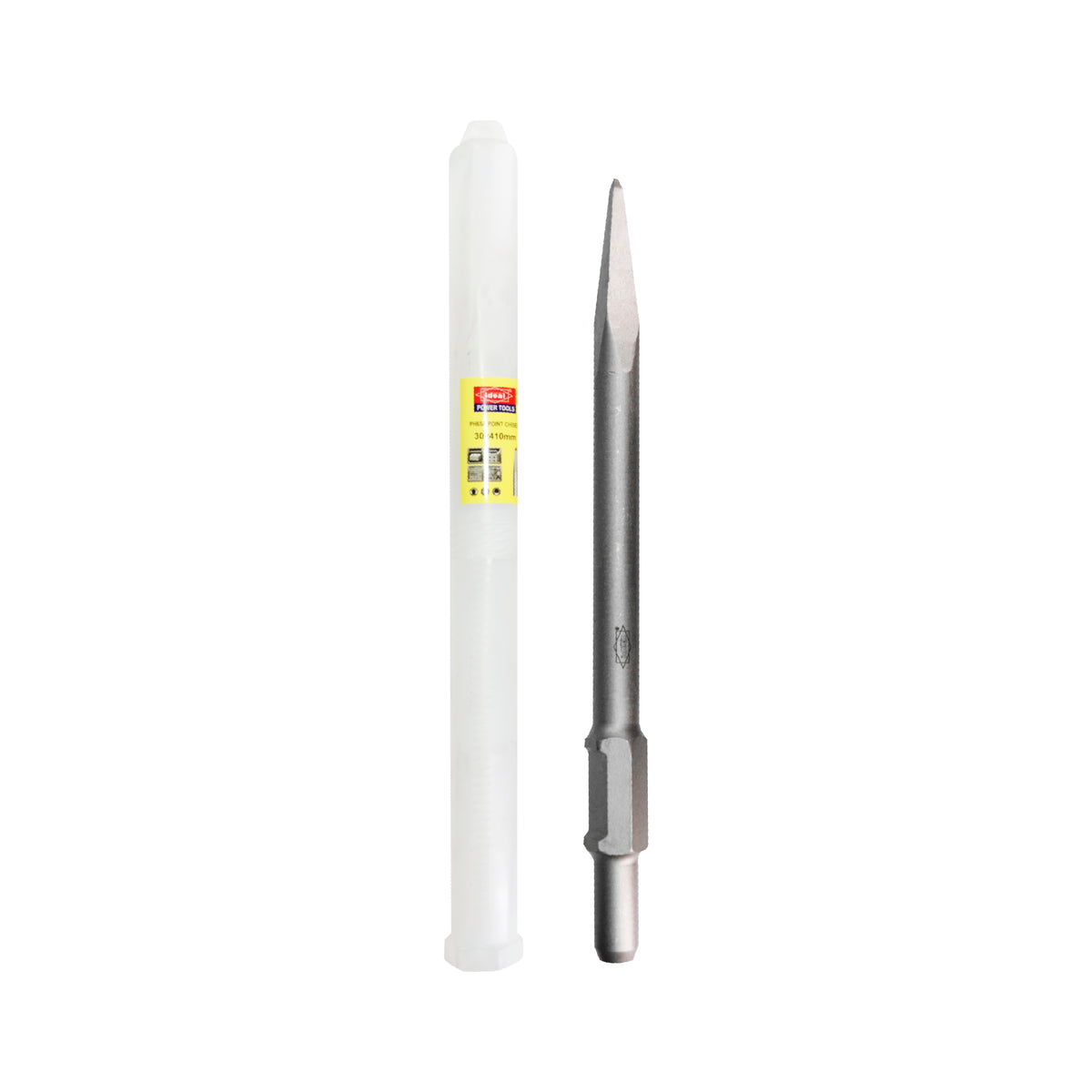
The IDEAL Pointed Chisel 30 × 410 mm [PH65], Model 20334 is a demolition hammer accessory designed for targeted concrete breaking, brickwork and mortar removal. Its pointed tip concentrates impact on a small contact area for controlled material removal, while a strong shank and heat-treated tip support durability and resistance to wear during demanding chipping work.
| Key Features | Perfect For |
|---|---|
|
|
Focused Breaking Power for Concrete, Brickwork and Masonry
- Pointed profile for concentrated impact: The narrow working tip directs the hammer’s impact into a small contact area. This makes the chisel useful for initiating breaks and removing material at selected points rather than applying impact across a broad cutting edge.
- 30 × 410 mm specified dimensions: This demolition hammer accessory is identified by its 30 × 410 mm size. Match these dimensions, the PH65 designation and the actual shank profile to your machine’s approved accessory requirements before installation.
- Heat-treated tip for demanding applications: The working tip is heat-treated to support durability and resistance to wear during repeated contact with concrete and masonry. This feature helps the accessory withstand the demands of impact-driven breaking and chipping work.
- Strong shank for repeated hammer impacts: The robust shank forms the connection between a compatible machine’s tool holder and the working tip, supporting hammer-driven material removal during construction, repair and demolition tasks.
- Concrete, brickwork and mortar removal: The pointed chisel suits several masonry applications, including breaking concrete, removing brickwork and chipping away mortar. Its focused contact point is useful when work must begin in a selected location.
- Targeted positioning for controlled chipping: The pointed shape allows the operator to select the initial impact location precisely. Removal results depend on the material, machine output, accessory condition and operating technique.
- Clear model identification for replacement selection: The IDEAL Model 20334 carries the PH65 designation. Confirm the required shank profile and retention system before fitting. Compatibility with every demolition hammer, hammer drill, rotary hammer or chipping hammer is not established by the supplied product information.
This product is the IDEAL pointed chisel accessory, Model 20334, specified as 30 × 410 mm [PH65], rather than a powered demolition hammer. Additional included components and certification details are not specified in the supplied product information.
General Purchase & Comparison Queries
What is the IDEAL 20334 pointed chisel used for?
The IDEAL 20334 pointed chisel is a demolition hammer accessory for concrete breaking, brickwork and mortar removal. Its pointed tip concentrates impact at a selected contact point, making it useful for targeted chipping with a compatible machine.
How does a pointed chisel differ from a flat chisel?
A pointed chisel concentrates impact at a narrow point for initiating breaks and localised demolition. A flat chisel applies contact across a wider edge and is generally chosen for broader cutting or removal. Select the profile according to the material and the task.
Will this pointed chisel fit my demolition hammer?
Compare your machine’s approved accessory requirements with the 30 × 410 mm size, PH65 designation and shank profile. The tool holder and locking system must match the accessory. Universal compatibility with demolition hammers, rotary hammers or hammer drills is not confirmed by the supplied information.
Product-Specific and Usage Queries
What are the dimensions and model number?
This accessory is the IDEAL Pointed Chisel, Model 20334, with a specified size of 30 × 410 mm and the PH65 designation. Use these details when checking suitability or selecting a replacement.
What features support durability and wear resistance?
The chisel features a strong shank and heat-treated tip. These features support durability and resistance to wear during repeated hammer-driven breaking. Actual service life depends on the material, machine, operating technique and maintenance.
Can this chisel be used for brickwork and mortar removal?
Yes, brickwork and mortar removal are among its stated applications. The pointed tip helps focus impact on selected areas. Work cautiously when adjacent masonry must remain intact, as hammer impacts can also crack or loosen surrounding material.
Problem/Solution-Oriented Queries
Which chisel is useful for starting a break at a specific point?
A pointed chisel is useful when impact needs to be concentrated at a selected location. The IDEAL 20334’s pointed tip supports focused breaking in concrete and masonry rather than the broader contact produced by a flat chisel.
What should I do if the chisel does not fit my machine?
Do not force or modify the chisel to make it fit. Disconnect the machine from its power source and check the approved accessory specifications against this chisel’s dimensions, shank profile and PH65 designation. Use an accessory confirmed to match the machine’s tool holder and retention system.
What should I check if breaking performance decreases?
Disconnect the machine from its power source, then inspect the tip and shank for wear, cracks or damage and check that the accessory is correctly fitted. Follow the machine manufacturer’s maintenance guidance and replace damaged accessories. Performance also depends on the material and the hammer’s operating condition.