
ID GPM800 [800W] ELECTRIC PAINT MIXER MACHINE [G-240V] - 26023


 Chat with us
Choose options
Professional Power, Precision Mixing — Every Time
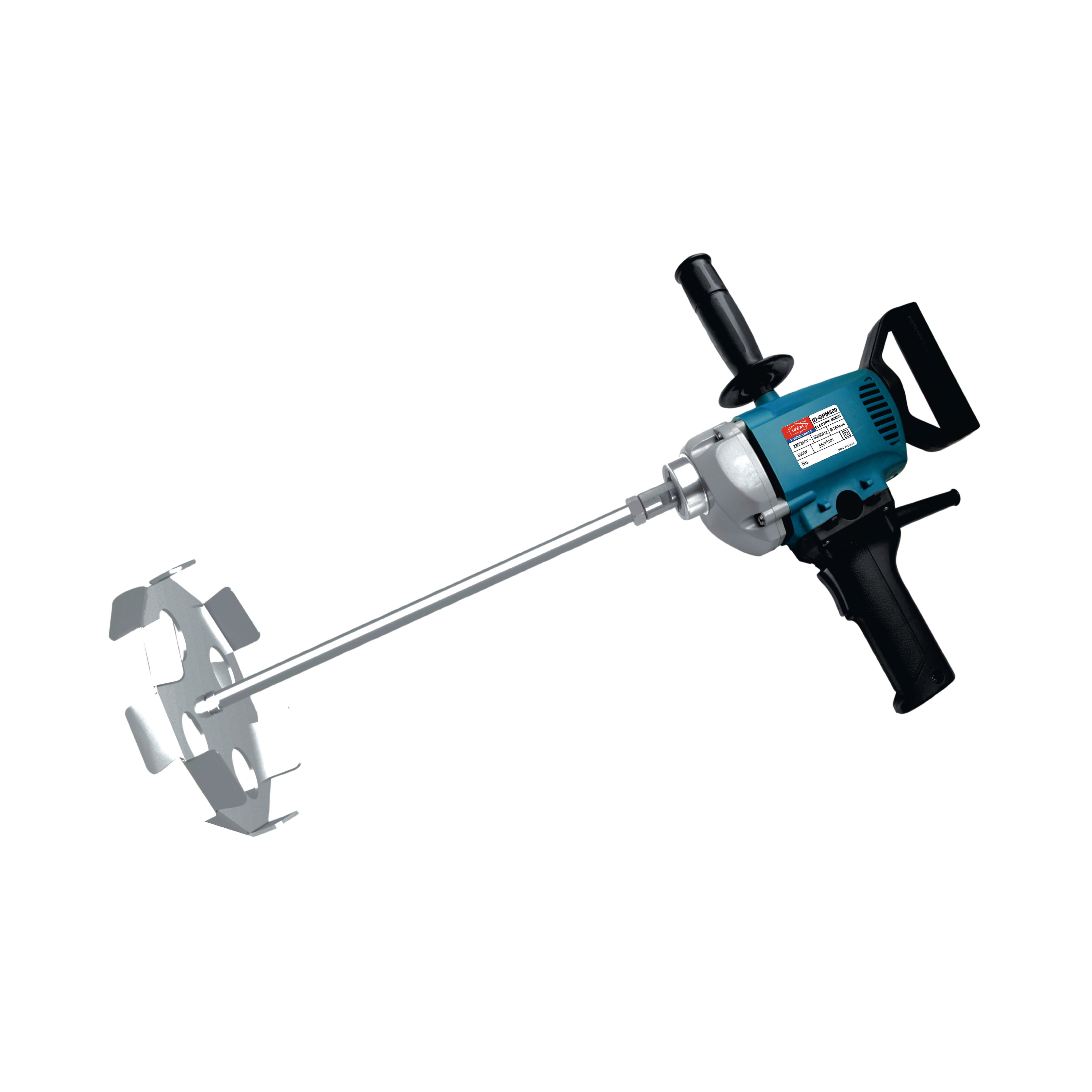
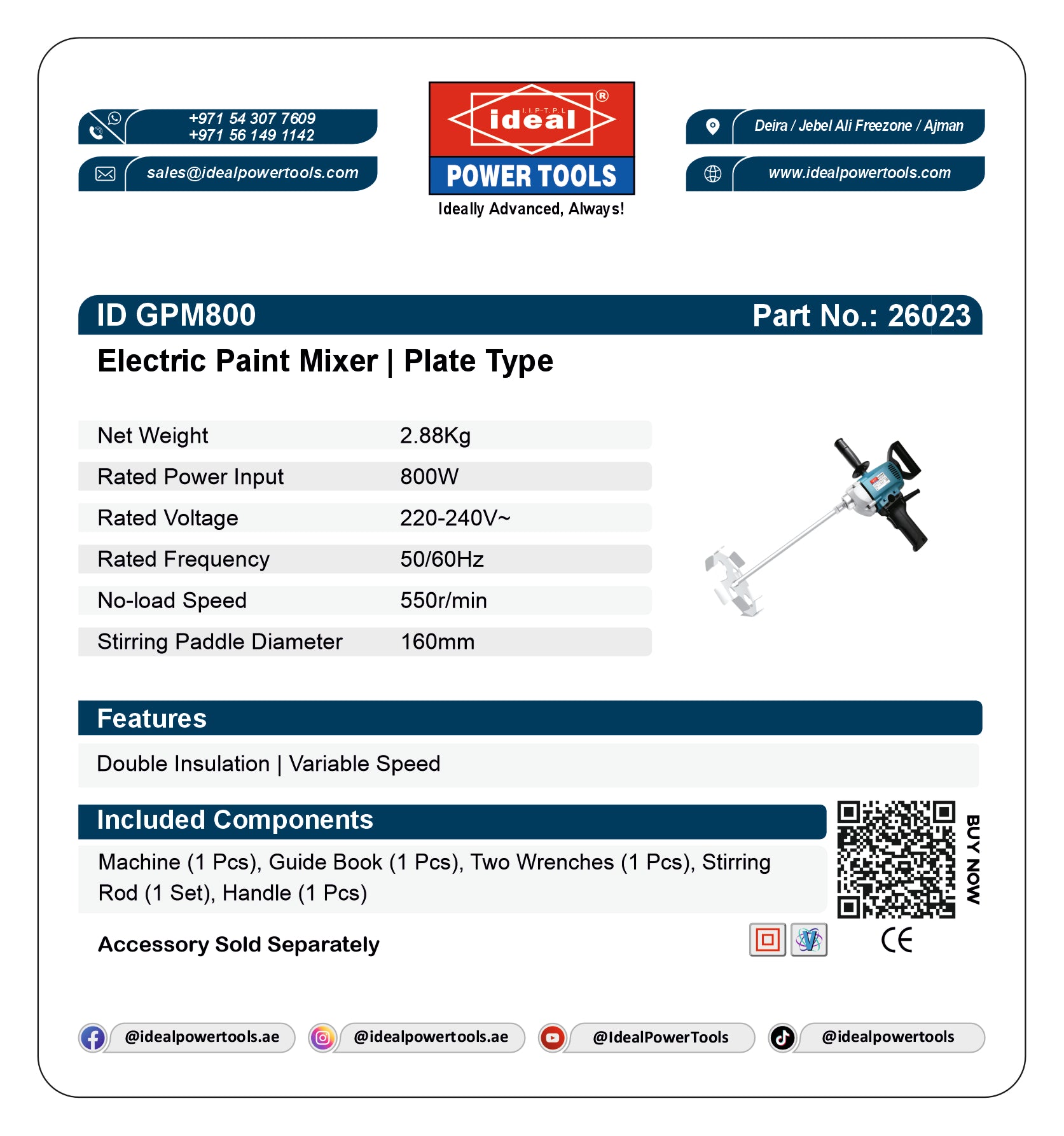
The ID GPM800 Electric Paint Mixer Machine is a professional-grade 800W variable-speed paint mixing machine engineered for demanding painting, construction, and industrial applications. Fitted with a Type G British 3-Pin plug and rated at 220–240V / 50–60Hz, this electric paint mixer delivers consistent, lump-free blending of paints, coatings, adhesives, and other viscous liquids. Its double-insulated motor housing and CE-certified construction make it a reliable choice for professionals who demand both safety and performance on every job.
| Key Features | Perfect For |
|
|
- 800W Rated Power Input — The GPM800 delivers a robust 800 watts of continuous power, providing the torque needed to break down settled pigments, blend thick coatings, and homogenise multi-component materials without bogging down or overheating during extended use.
- Variable Speed 0–550 r/min — The fully adjustable no-load speed range of 0 to 550 revolutions per minute gives operators precise control over mixing intensity, allowing gentle agitation for thin emulsions or aggressive blending for heavy-bodied mastics and epoxy coatings.
- Double Insulation Safety Design — Engineered with a double-insulated motor and outer casing, the electrical components are completely isolated from any touchable surface, eliminating the risk of electric shock even in damp or wet site conditions — a critical safety feature for professional environments.
- M160 Stirring Paddle Thread Diameter — The standardised 160mm thread diameter on the mixing shaft ensures compatibility with a wide range of commercially available stirring paddles and rods, making it easy to swap attachments for different mixing tasks or container sizes.
- 220–240V / 50–60Hz Universal AC Input — Designed for standard mains voltage across the UAE, UK, Europe, and GCC regions, the GPM800 operates reliably on both 50Hz and 60Hz power supplies, making it suitable for international job sites and multi-region distribution.
- Type G British 3-Pin Plug — Plug-and-Play Ready — Ships with a Type G (BS 1363) plug pre-fitted, meaning it is immediately ready for use in the UAE, UK, and other Type G markets without the need for adapters or rewiring.
- Complete Kit Included — The GPM800 ships as a fully equipped package: the machine itself, a stirring rod set, a handle, two wrenches for paddle installation and removal, and a guide book — everything needed to get started straight out of the box. It carries a CE (Machine Test) conformity certificate, confirming it meets European safety and electromagnetic compatibility standards.
General Purchase & Comparison Queries
What voltage and plug type does the GPM800 use — is it compatible with UAE and UK sockets?
The ID GPM800 operates on 220–240V AC at 50/60Hz and comes fitted with a Type G British 3-Pin plug (BS 1363). This makes it immediately compatible with standard wall sockets in the UAE, UK, Ireland, Hong Kong, Singapore, and other Type G markets — no adapter required. Simply plug in and start mixing.
How does the GPM800 compare to a standard drill with a mixing attachment?
Unlike a standard drill repurposed for mixing, the GPM800 is purpose-built as a dedicated paint mixer. Its 800W motor is optimised for sustained low-to-mid speed torque rather than high-speed drilling, which means it handles thick coatings, adhesives, and heavy-bodied paints without the motor strain or overheating common in converted drills. The variable speed dial (0–550 r/min) also provides far more precise control than a drill trigger, and the M160 paddle thread is a professional standard fitting not found on most drill chucks.
Is the GPM800 certified and safe for professional use on construction sites?
Yes. The GPM800 carries a CE (Machine Test) conformity certificate, confirming it meets European Union safety, health, and electromagnetic compatibility directives for power tools. Its double-insulated design — where all live electrical components are fully isolated from the outer casing — provides an additional layer of protection against electric shock, making it suitable for professional use in painting, construction, and industrial environments.
Product-Specific and Usage Queries
What materials can the GPM800 mix, and what container sizes is it suited for?
The GPM800 is designed to mix paints, emulsions, primers, varnishes, adhesives, tile grout, epoxy resins, and other viscous coatings. With its 800W motor and variable speed up to 550 r/min, it handles both water-based and solvent-based products. The included stirring rod set with M160 thread is suited for standard 5-litre to 25-litre buckets and drums commonly used on construction and painting projects.
How do I attach and remove the stirring paddle, and what tools are needed?
The GPM800 uses a standard M160 threaded spindle to secure the stirring rod. The package includes two wrenches specifically for tightening and loosening the paddle connection — no additional tools are required. Simply thread the stirring rod onto the spindle and use the wrenches to lock it firmly in place before operation. Always ensure the machine is unplugged before attaching or removing any accessories.
What is the no-load speed, and how does variable speed control work?
The no-load speed of the GPM800 ranges from 0 to 550 r/min, fully adjustable via the speed control dial. "No-load" speed refers to the motor's RPM when the paddle is spinning freely without resistance. Under load — when mixing thick materials — the effective speed will be lower, which is normal for all variable-speed mixers. Start at a low speed setting when first inserting the paddle into a full bucket to prevent splashing, then gradually increase to the desired mixing intensity.
Problem/Solution-Oriented Queries
The mixer feels like it is struggling or slowing down when mixing thick material — what should I do?
If the GPM800 slows noticeably under load, first reduce the speed dial setting — running at maximum speed with very thick materials puts unnecessary strain on the motor. Allow the machine to work at a moderate speed and let the paddle do the work gradually. If the material is extremely stiff (e.g., thick tile adhesive or epoxy), consider pre-mixing manually with a stick to break the surface before using the machine. Ensure the stirring rod is fully tightened using both wrenches, as a loose paddle can cause vibration and apparent loss of power. If the issue persists, allow the motor to cool for 10–15 minutes before resuming — the 800W motor is rated for professional use but benefits from rest intervals during continuous heavy-duty sessions.
Paint is splashing out of the bucket when I start mixing — how do I prevent this?
Splashing is almost always caused by starting at too high a speed or inserting the spinning paddle too quickly into the liquid. Always insert the stirring rod into the paint before switching the machine on, or start the machine at the lowest speed setting (close to 0 r/min) before submerging the paddle. Gradually increase speed once the paddle is fully immersed. For large containers, position the paddle off-centre and angled slightly rather than straight down — this creates a controlled vortex rather than a direct upward splash pattern.
The stirring rod seems loose or wobbles during operation — what is the fix?
A wobbling stirring rod is almost always the result of an insufficiently tightened M160 thread connection. Switch off and unplug the machine immediately, then use both included wrenches to firmly re-tighten the stirring rod onto the spindle. One wrench holds the spindle stationary while the other tightens the rod — using only one wrench is a common cause of under-tightening. If wobble persists after proper tightening, inspect the thread on both the spindle and the rod for damage or debris, and clean before re-attaching.
Machine (1 Pcs), Guide Book (1 Pcs)